
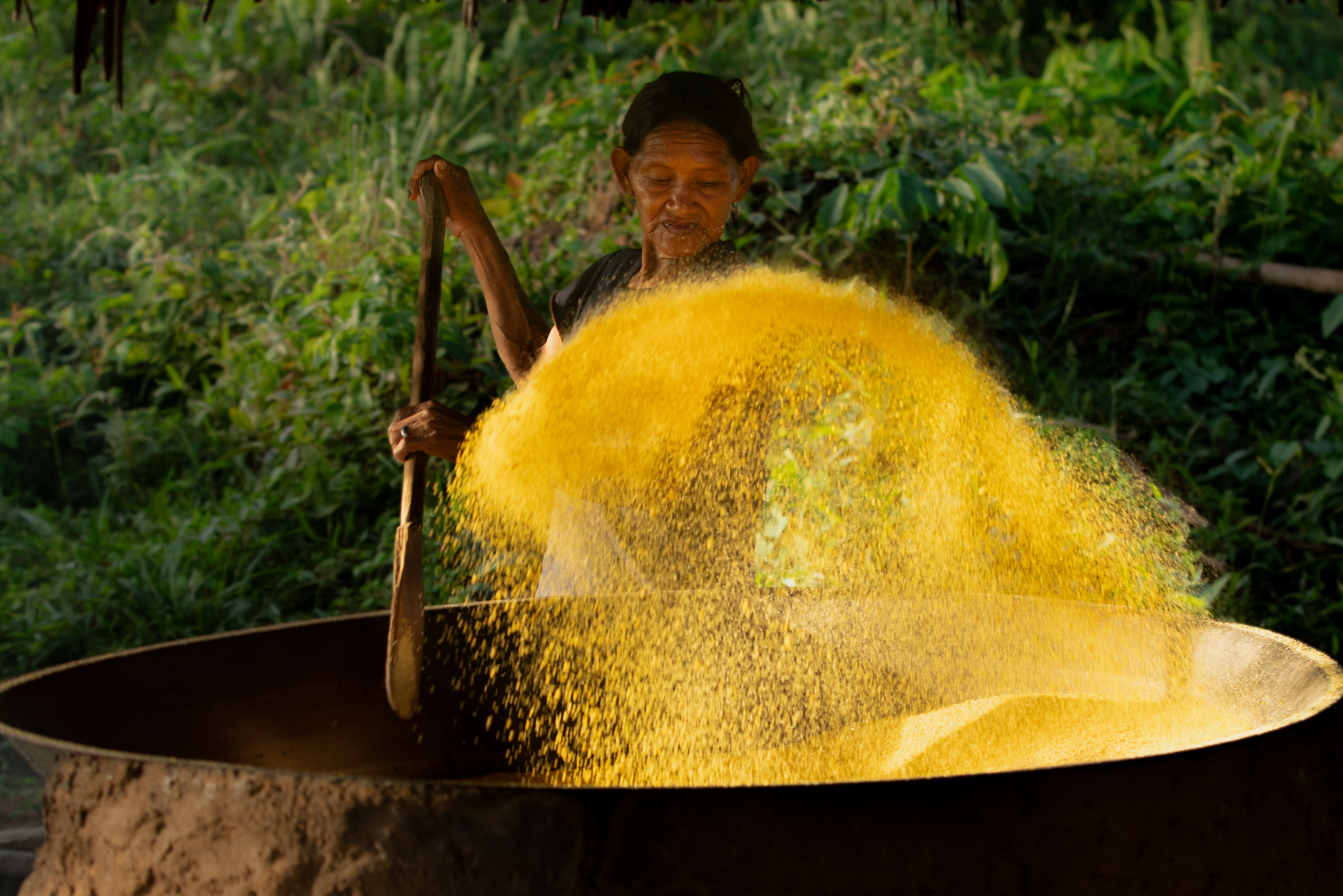
FOTOGRAFÍA: Felipe Rodríguez - Fundación Gaia Amazonas | At the United Indigenous territory of the rivers Isana and Surubí
In the eastern Colombian Amazon, the knowledge systems of Indigenous Peoples support comprehensive life systems that guarantee the Amazon’s health and integrity.
These ways of life include their own food systems that promote the abundance of nutritious food in reciprocal relationships with nature.
For Indigenous Peoples, food is an essential part of a complex system that, beyond nourishing bodies, nourishes identity, collective memory, and the material and spiritual connection with the territory—aspects that come together to truly nourish existence.
Food sustains life in its broadest sense: at a communal, territorial, spiritual, and cosmogonic level. Thus, thinking about food as a fundamental right implies recognizing the diversity and complexity of Indigenous food systems, their holistic ways of life, and their reciprocal relationship with nature, as well as the ways in which they bring together material, immaterial, spiritual, political, economic, and territorial governance aspects.
This proposal paves the way towards respecting and guaranteeing the rights of Indigenous Peoples, in which territorial rights are fundamental for building more just, sustainable, and diverse societies. It is a concrete expression of the right to food, to a dignified life, to cultural identity, to territory, and to autonomy. Because food is not only about nourishing bodies, but also about sustaining lives, cultures, and territories in all their complexity and diversity. And in this task, Indigenous Peoples have much to teach and the right to decide.
In some Indigenous Territories of the eastern Colombian Amazon, food systems are not only a guarantee of food autonomy and sovereignty but have also become a pathway toward economic autonomy, especially for women. This is the case of the women of the Indigenous Territorial Entity of the Río Pirá Paraná and its initiative to commercialize chili pepper.
There, the chili pepper project was born from the heart of their own knowledge systems, where ají (chili pepper) holds deep cultural significance. This project continues the work initiated by the Mothers of Seeds group and represents a way to put into practice everything they have learned about seeds and the chagra. It emerges from within their governance system, through the Women’s Coordination, as a women-led enterprise that ensures the production of chili both for their own consumption and for trade.
“We are pioneers in our work with chili peppers, and our efforts go far beyond commercial purposes: they strengthen our knowledge system, enable the transmission of ancestral wisdom to younger generations, consolidate our seed bank within the territorial governance structure, and affirm our role in sustaining buen vivir (good living).” – Women of the Indigenous Territorial Entity of the Río Pirá Paraná.
Learn more about this holistic perspective on chili peppers:
